
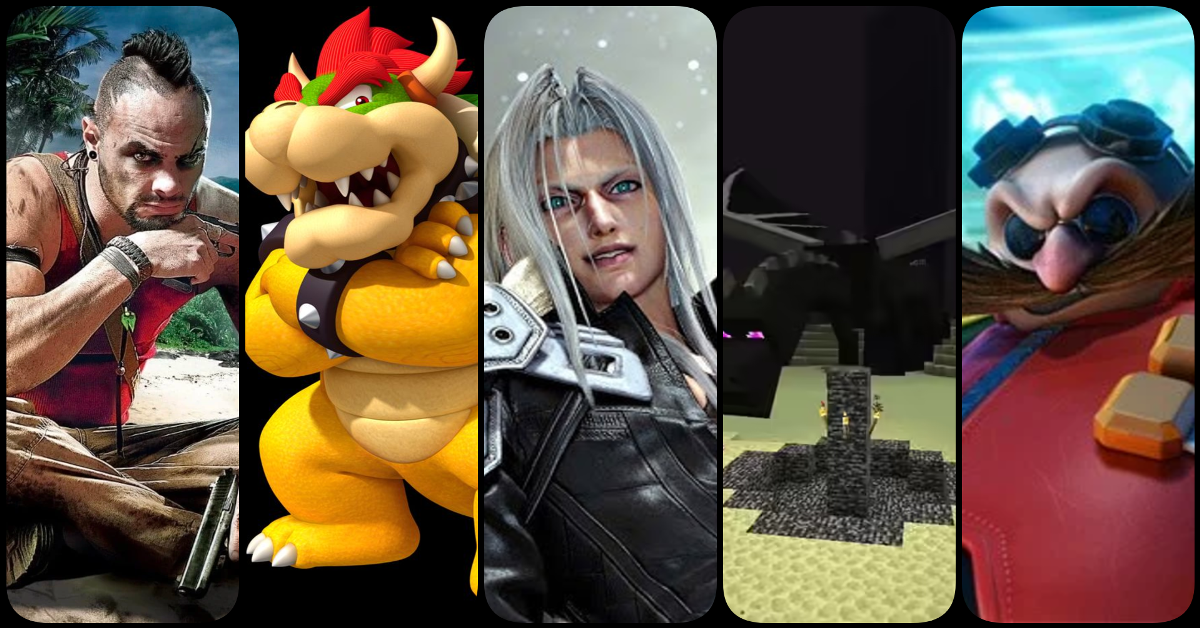
Video games are remembered for many things, including gameplay, environments, music, and heroes, but what truly distinguishes a classic game is its antagonist. Every challenge the player meets is meaningful thanks to a formidable enemy. Without a compelling foe, the hero’s quest feels hollow. With one, every stride forward feels deserved.
Iconic video game villains do not exist solely to be defeated. They influence the tone of the plot, push the hero to their limits, and frequently remain in our minds long after the game is over. Some villains frighten us, make us angry, and even make us wonder if they were genuinely bad at all.
Gaming has progressed from simple arcade experiences to complex narrative-driven worlds, and villains have developed alongside it. From classic cartoon antagonists to deep psychological personalities, these characters have shaped whole series and generations of gamers.
This blog delves at the most legendary video game villains of all time, focusing on what makes them memorable—not only their power, but also their personality, ideology, and long-term impact on gaming culture.
1. Bowser – The King of Enduring Evil
Bowser is one of the earliest and most well-known villains in video game history. Bowser, Mario’s perennial antagonist, has terrorized the Mushroom Kingdom for decades, but he never feels out of date. His design, personality, and job have evolved over time, while retaining his essential essence.
Bowser’s iconic status stems from his consistency. He does not require a tragic backstory or philosophical reason. He wants power, control, and Princess Peach—simple, unchanging aims. However, this simplicity is precisely why he works. Players quickly grasp who Bowser is and what he represents.
Bowser has evolved into a multifaceted antagonist over time. Games have revealed his pride, jealousy, ego, and even moments of levity. He occasionally pairs up with Mario to face a larger threat, reminding players that he is more than just chaos—he is a persistent rival.
Bowser is still iconic because he demonstrates that a villain does not need depth to be renowned. Presence, tenacity, and personality are sufficient.
2. Ganondorf – The Eternal Curse of Power
Ganondorf is more than just a bad guy; he is a timeless example of evil. Ganondorf is a symbol of ambition, greed, and the corrupting effects of power in the Legend of Zelda series. Ganondorf repeatedly reappears, reborn throughout timelines, in contrast to villains who come and die.
Ganondorf’s intelligence is what makes him unique. He doesn’t charge headlong into combat. He waits patiently for the ideal opportunity to attack, manipulates politics, and takes advantage of vulnerabilities. Frequently, the harm has already been done when Link confronts him.
The belief that evil is difficult to eradicate is strengthened by Ganondorf’s multiple reincarnations. It persists, waiting for another chance, even after being vanquished. Few villains have the air of inevitability that Ganondorf does because of this epic aspect.
He feels more like a curse sewn into the fabric of the universe than a human, which makes him iconic.
3. Sephiroth – The Fallen Angel of Gaming
Many people consider Sephiroth from Final Fantasy VII to be one of the best video game antagonists ever made. His serene manner, immense strength, and sad beginnings all work together to make him an intriguing and dangerous figure.
Sephiroth’s metamorphosis is what makes him so memorable. He was once hailed as a hero, but after learning the truth about his background, he spirals into insanity. His fall from grace gives his villainy more emotional weight. In addition to being afraid of him, players lament his transformation.
Despite his few appearances, Sephiroth has an even greater impact. He doesn’t pursue the player all the time. Rather, his presence is sensed through atmosphere, recollection, and ruin. Just listening to his theme tune can make you uncomfortable.
Sephiroth is iconic because he represents the danger of identity loss and obsession, wrapped in one of the most striking designs gaming has ever seen.
4. Dr. Eggman – Genius Driven by Ego
Robotnik, aka Dr. Eggman, is the ideal antithesis of Sonic the Hedgehog. Eggman stands for dominance, intelligence, and control, whereas Sonic stands for freedom, speed, and instinct.
Eggman’s conceit is the source of his villainy. He sincerely feels that because he is brighter than everyone else, he should be in charge of the entire world. His never-ending supply of machines, traps, and plans is fueled by this idea.
Eggman’s personality is what makes him famous. He is blatantly malicious, boisterous, and theatrical. However, his conflict with Sonic is more ideological than physical, thus he never gets dull.
Because he demonstrates that intelligence without humility can be just as destructive as sheer force, Eggman will always be remembered.
5. Vaas Montenegro – Madness That Feels Real
Vaas from Far Cry 3 altered the way gamers perceived modern video game villains. He is not motivated by philosophy or long-term goals; he feeds on chaos, fear, and psychological dominance.
Vaas is terrifying because he seems unpredictable. His abrupt mood swings keep players on edge. He’s calm one moment and violent the next. Every interaction with him is awkward and risky due to his volatility.
His legendary lectures dramatically violate the fourth wall, leaving players feeling intimidated rather than challenged.
Vaas is memorable because he demonstrated that a villain does not have to be present throughout the game to have a lasting impact. Intensity matters more than screen time.
6. Handsome Jack – The Villain Who Thinks He’s the Hero
Handsome Jack from Borderlands 2 is one of the best-written antagonists in gaming. He is simultaneously charismatic, amusing, and vicious.
What distinguishes Handsome Jack is his self-perception. He truly feels that he is saving the world. In his mind, the player is the antagonist, threatening order and development.
This twisted morality fascinates Jack. He is not insane; he is convinced. His conviction in his own righteousness makes his conduct even more troubling.
Handsome Jack is renowned because he exemplifies how dangerous conviction is when combined with power.
7. GLaDOS – Cruelty Through Logic
GLaDOS, the villain from the Portal series, is unlike any other. She is an artificial intelligence without empathy, yet her sardonic demeanor makes her feel alarmingly alive.
GLaDOS does not attack directly. She manipulates situations, creates difficult tests, and patiently observes failure. Her sense of humor contrasts dramatically with the danger she represents, generating a distinct tone of dread.
As the novel progresses, glimpses into her background emerge, adding complexity without justifying her harshness.
GLaDOS is iconic because she exemplifies how intelligence without emotion can turn into cold, planned evil.
8. Andrew Ryan – Ideology as a Villain
BioShock’s Andrew Ryan isn’t your typical adversary. He depends on ideas rather than power or fear.
Ryan is an individualist who values complete independence. This idea is reflected in the underwater metropolis he created, Rapture. It collapses because of the weaknesses in his beliefs, not because of outside adversaries.
Andrew Ryan’s ideology challenges the player, which is what makes him memorable. His narrative compels players to consider morality, control, and free will.
Because he demonstrates that thoughts are just as powerful as weapons in destroying entire universes, Andrew Ryan is a legend.
9. The Ender Dragon – A Symbolic Final Enemy
Rather than having a distinct personality, the Ender Dragon from Minecraft is famous for its symbolism. It doesn’t talk, make fun of, or give an explanation. It only exists as the greatest obstacle.
It takes preparation, persistence, and exploration to reach the Ender Dragon. Because the trip is completely player-driven, losing it feels personal.
Rather than symbolizing evil, the Ender Dragon is a last challenge that signifies the conclusion of one chapter and the start of a new one.
It is unforgettable because of its quiet.
10. Pyramid Head – Guilt Made Flesh
Pyramid Head from Silent Hill is a psychological manifestation rather than merely a villain. He stands for retribution, guilt, and internal suffering.
In contrast to conventional adversaries, Pyramid Head serves as a reminder of the protagonist’s transgressions. There is always a sense of fear due to his slow movement and intimidating presence.
Because he demonstrates that the most scary villains are reflections of the human mind, Pyramid Head has become iconic.
Why These Villains Endure
Iconic video game villains remain because they are more than just difficulties. They represent anxieties, ideas, and emotional conflicts that gamers can identify, even subconsciously.
Some villains are terrifying because of their power. Others cause disturbances through psychology. Some tests players morally rather than mechanically.
These villains are remembered because they made us experience true emotions.
Evil That Shaped Gaming History
The most legendary video game villains of all time rose to prominence through outstanding narrative, unforgettable design, and emotional effect. They did not simply oppose heroes; they defined them.
As gaming evolves, new villains will arise. However, these legends will always serve as benchmarks for what a really unforgettable antagonist looks like.
They are not simply villains.
They’re part of gaming history.