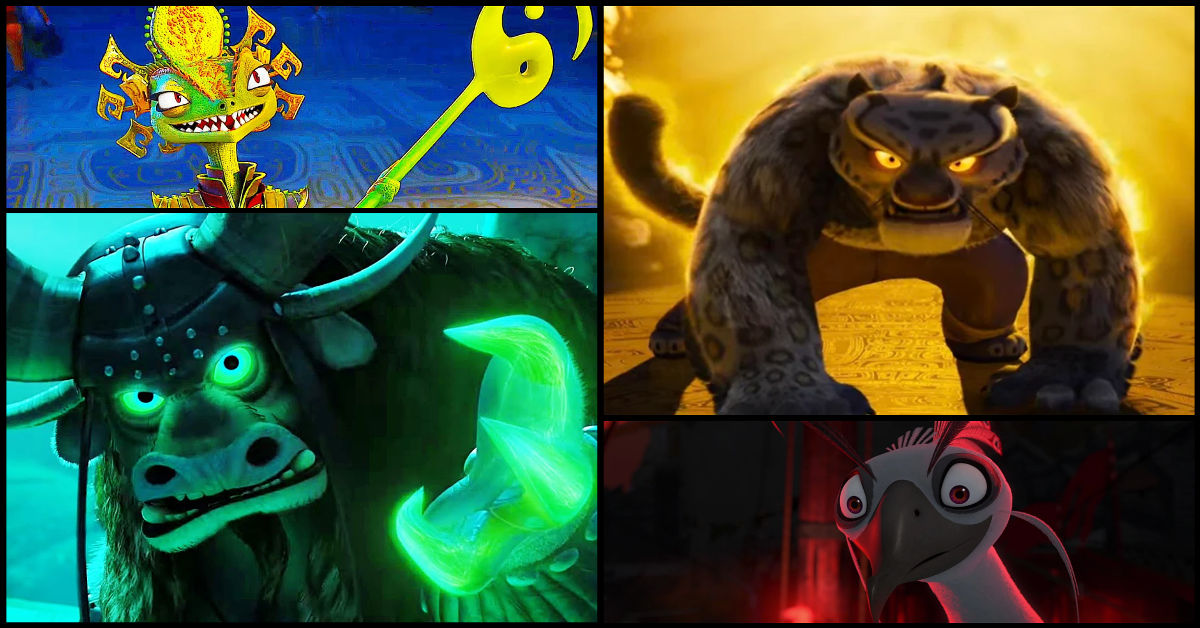
The Kung Fu Panda franchise differs from many other animated programs in its in-depth exploration of villainy. Instead than depending solely on “good versus evil” storytelling, the films feature adversaries that are emotionally grounded, philosophically nuanced, and symbolically powerful. Each main villain in Kung Fu Panda is more than just a barrier for Po to conquer; they are also reflections of what Po could have been under different circumstances.
Throughout the franchise, four key villains serve as the emotional and conceptual backbone of the story: Tai Lung, Lord Shen, Kai, and The Chameleon. Each enemy represents a different type of personal battle – entitlement, obsession, a desire for control, and identity theft — and each forces Po to mature not only as a warrior, but also as a spiritual and emotional person.
This article is a complete deep-dive into all four main Kung Fu Panda villains, examining their motives, powers, and downfall, while exploring how each antagonist shapes the emotional and philosophical journey of the franchise.
1. Tai Lung: The Fallen Prodigy Who Believed Destiny Was Owed
Tai Lung is the Kung Fu Panda series’ first major villain and, in many ways, its most tragic. Tai Lung was raised by Master Shifu as a son rather than a pupil, and he grew up believing that greatness was his destiny. His kung fu talent was evident from a young age. He practiced harder than anybody else, mastered methods beyond his years, and earned the respect of practically everyone around him. This continual adulation gradually formed his personality around a single belief: that he was entitled to the greatest recognition.
Tai Lung’s villainy stems from a lack of balance in expectations. Shifu’s pride in his student turned into emotional dependency, and Tai Lung internalized the belief that his worth was solely dependent on attaining the greatest award. When he was denied the Dragon Scroll, it crushed his self-esteem. Instead of viewing it as a lesson in humility, Tai Lung saw it as treachery.
His motivation was never just power or devastation. Tai Lung sought validation. He sought assurance that all of his years of sacrifice, discipline, and misery had been worthwhile. The denial of the scroll turned his wounded pride into wrath, and his yearning for acknowledgment became a desire for vengeance. In his perspective, the world owed him what he deserved.
Powers
Tai Lung is perhaps the franchise’s most physically formidable villain. His knowledge of kung fu is comprehensive, nuanced, and devastatingly exact. He mixes speed, strength, agility, and technical expertise to become nearly unstoppable. His most recognizable ability is his mastery of nerve blows, which allow him to paralyze opponents with little effort. This strategy represents his idea of control via supremacy.
Tai Lung is particularly dangerous because of his discipline as well as his strength. He battles with conviction, clarity, and merciless efficiency. Unlike other villains who rely on supernatural capabilities, Tai Lung’s skills are solely derived from training and skill, emphasizing the notion that he represents what happens when talent is consumed by pride.
Downfall
Tai Lung’s downfall is profoundly emotional rather than physical. Despite his immense might, he is eventually defeated because he cannot adapt. His entire identity is based on the concept that worth must be gained via dominance. When Po defeats him via resilience, ingenuity, and self-acceptance rather than better technique, Tai Lung is perplexed and outraged.
The discovery that the Dragon Scroll holds no secret power ruins Tai Lung’s worldview. Everything he believed in crumbled at once. His fall is more than a battle loss; it is a full ideological catastrophe. Tai Lung fails because he never grasped the lesson that Po exemplifies from the start: greatness comes from believing in oneself rather than seeking acclaim from others.
2. Lord Shen – The Tyrant of Destiny
Lord Shen is the most mentally sophisticated antagonist in the Kung Fu Panda franchise. Unlike Tai Lung, who is driven by wounded pride, Shen is motivated by dread—specifically, fear of fate. A prophesy predicted that a black and white warrior would overcome him, but instead of accepting or reflecting on this prediction, Shen attempted to destroy the future itself.
Shen’s motivation is control. He cannot accept the thought that his fate is beyond his control. His murder of pandas is more than just a horrible crime; it is an attempt to erase destiny. He makes every decision based on worry and obsession. Shen does not seek power for its own sake; rather, he seeks assurance in a world that scares him.
The dread is exacerbated by rejection. Shen, who was banished by his parents for his aggressive deeds, internalizes abandonment and turns it into arrogance. He convinces himself that compassion is a sign of weakness, whereas mercy only leads to vulnerability. As a result, he isolates himself emotionally, producing a self-fulfilling prophecy of loneliness and destruction.
Powers
Lord Shen may not be the strongest villain physically, but he is the most technologically threatening. His knowledge of weaponry, notably fireworks and early cannons, offers a new type of threat to the kung fu community. Shen represents development without wisdom, innovation motivated by fear rather than insight.
His fighting style is both graceful and deceiving. Shen fights like a performer, with swords hidden in his feathers and flawless acrobatic motions that conceal lethal intent beneath grace. His greatest strength, however, rests in his intelligence and strategic thinking. Shen fights war not via physical combat, but through persuasion, preparation, and psychological intimidation.
Downfall
Shen’s demise stems from his inability to let go. Po eventually beats him, not by overwhelming him, but by confronting his own past and finding inner peace. This contrasts sharply with Shen’s inability to let go of his guilt, fear, and obsession with prophecy.
In the last showdown, Shen is given the opportunity to pause, to turn away from his deadly path. He declines. His reluctance to tolerate uncertainty causes him to stand beneath his own falling structure. Symbolically, Shen is crushed by the weapon he created to dominate destiny. His downfall is the terrible result of prioritizing fear above comprehension.
3. Kai – The Collector of Souls
Kai, introduced in Kung Fu Panda 3, represents the danger of unchecked ego. Once a brother-in-arms to Master Oogway, Kai’s fall begins when gratitude turns into entitlement. After learning the art of chi, Kai believes that power should be taken, not earned. His motivation is domination—not over territory, but over identity itself.
Kai’s concern with collecting chi represents his notion that strength resides beyond oneself. He determines value by accumulation. Every vanquished master becomes another prize, strengthening his belief that power makes him whole. Unlike Tai Lung and Shen, Kai desires immortality through victory rather than external validation.
Powers
Kai is the franchise’s most openly supernatural villain. His ability to steal and manipulate chi enables him to enslave great warriors and transform them into jade warriors under his command. His physical strength is enormous, bolstered by magical weaponry and brute force.
However, Kai’s greatest strength is metaphorical. He symbolizes the urge to define achievement via dominance. His green jade chains are more than just weapons; they are symbols of control, binding others to his will.
Downfall
Kai’s demise stems from a misunderstanding of chi. He believes it can be obtained through force, but Po discovers that true chi comes from harmony and connection. In the Spirit Realm, Po willingly gives Kai more chi than he can bear, which overwhelms him.
This moment is critical. Kai is defeated not through opposition, but by giving. His failure to grasp selflessness is his undoing. Kai’s ego falls when confronted with boundless energy that comes from togetherness. He is consumed by the power he attempted to control.
4. The Chameleon – The Thief of Identity
The Chameleon, first seen in Kung Fu Panda 4, represents a new type of villain: insecurity. The Chameleon, unlike past villains, steals rather than trains or conquers. Her motivation derives from being denied respect and opportunities. Instead of creating her own personality, she chooses to rely on the strength of others.
Her bitterness develops into infatuation. The Chameleon feels that excellence is something external that can be replicated. Her actions stem from a strong sense of inadequacy, resulting in a villain shaped by comparison rather than ambition.
Powers
The Chameleon’s ability to shapeshift and mimic the powers of previous villains makes her particularly dangerous. She represents the franchise’s history, using stolen identities as weapons. However, these abilities lack authenticity. She imitates power without comprehending its origins.
Her power enables her to defeat opponents through deceit, forcing them to confront familiar enemies in different shapes.
Downfall
The Chameleon’s loss stems from her lack of identity. When faced with Po’s authenticity, her borrowed power crumbles. She cannot maintain the identities she borrows since they are not her own. Her failure emphasizes one of the franchise’s central messages: true power comes from embracing oneself rather than emulating others.
➔ Each of Kung Fu Panda’s main villains depicts a distinct personal failure. Tai Lung fails to let go of entitlement, Shen fails to accept uncertainty, Kai fails to grasp humility, and the Chameleon fails to embrace identity. They form a compelling story about progress, balance, and self-acceptance.
Their defeats serve as not only victories for Po, but also lessons for the viewer. The franchise thrives because its villains are not caricatures of evil; rather, they are reflections of human weaknesses, heightened just enough to convey timeless truths.